Wednesday, April 2, 2014

Data-less Decision Making Made Easy by Google Analytics Academy

Perhaps I have been wrong.  I have spent so much time trying to convince dealer principals and car sales managers that fear the Internet that they need to be open to the world of digital marketing.  So much of my breath has been spent teaching that the power of digital marketing is in its constant undercurrent of data from which careful analysis can be drawn.  Over and over I have labored to find a way to gently explain how their fear of online marketing makes them look silly.
Eeeek! The Internets!

Today I learned (or, TIL in Reddit-speak) that perhaps I was wrong.

In keeping with my standard of staying on the cutting edge, I try to take advantage of every quality webinar or continuing education opportunity that I can find.  Among the helpful tools I have discovered is Google's Analytics Academy.

 I have completed two of their helpful course offerings so far.  When I checked in there today I discovered that the geniuses of Google have developed a new course that will help to empower those in the automotive industry who continue to dismiss all things digital.  (Almost all things, that is.  I have found many a manager or dealer principal who avoids using Internet assets for online business growth that finds online adult entertainment an indispensable part of his life.)

While it should be no surprise that an information juggernaut like Google should have managed to find a way to generate helpful content for almost any scenario, who could have guessed that they could create a course to help those who firmly believe that the Internet is a passing fad?  Well, they have done just that:

For those of you breathing a sigh of relief that finally there is help for you, the complete course outline can be accessed here.  If you are unsure if this course is for you, be sure to check out the FAQ page.

So for all of you out there that have been offended by my insistence that there exists a better way to grow your dealership, I apologize. 
Happy learning and stay classy!

Monday, March 31, 2014

Like Pope Francis, Execs Should Be Open to Ordinary Confessors

Once again Pope Francis is in the news "shocking the world" by actually living the Gospel.  In today's blockbuster, he broke from the tradition of the Holy Father having a specific, carefully chosen confessor to walking up to "an ordinary priest" in St. Peter's to make his confession.  I marvel that this should be news at all.  After all, the Church has always taught that even the Bishop of Rome himself is a sinner in need of confession.  The pontificate of Pope Francis has clearly been marked by his having adopted Saint Francis' maxim of "Spread the Gospel always, when necessary -- use words".  It makes sense, therefore, that having just exhorted the faithful on the importance of the Sacrament of Confession that he should approach the sacrament himself.  No pageantry, no lofty ceremonies -- just simply confess one's sins and experience the love of Christ through the sacrament.
So what does this have to do with digital marketing?

The Sacrament of Confession begins with an examination of one's conscience.  What have I done that has caused me to stray from the devout life?  What could I have done better?  How have I followed or not followed The Way?  While I would refer you to St. Francis DeSales, GK Chesterton, Dietrich von Hildebrand, or C.S. Lewis for the finer points of spiritual development my interest in this story is in exploring the importance of an executive examination of conscience.

I am not referring to issues of faith and morals, but the ability to take a candid, objective and curious look at one's marketing and sales processes and truthfully analyzing the results!

A quick perusal of my work history and one might speculate that either I interview like Dr. Jekyll and work like Mr. Hyde or I am particularly fond of exploring new opportunities.  A dealer principal will bring me on board because he/she wants to improve their digital marketing methods and get better results.
 I gather some baseline data and explain their current situation, and present my proposal for how to improve.  From this point we are the best of friends.
The problem begins when I conscientiously do my job.  Let me explain.

A good digital marketing program runs on good data.  It is in the collection of this data and in its analysis that often other issues or deficiencies often become apparent.  For example, increasing visitors but decreasing engagement could be a web design issue but it could also be an indicator, in the automotive sales business, that perhaps your inventory is lacking.  It could be a sign that pricing is not in line with the market, or that the inventory lacks diversity or appeal. It could be the manifestation of an existing or developing image or reputation problem. What if the closing ratio is decreasing?  Or margins are contracting?

So often we want an immediate answer.  Someone came in that didn't like a picture on the website therefore the website needs changed immediately!  A follow up on an unsold appointment revealed that the customer did not like what was said when they arrived therefore the sales staff is to blame!  Good data only becomes statistically relevant when you have collected a large enough and random enough sample for whatever is being measured

What does that mean?  It means that one story or one opinion is a sample of just that: one.  Often a dealer principal or experienced manager relies far too heavily on their opinion.  With your competitors collecting and then objectively mining their data, they could be gaining valuable market insights that will give them an edge while you sit confident that since you started your own business or have managed one successfully for a while you must be right. 
In just a few short years the habits of the internet customer have morphed considerably.  While the psychology of closing a deal has not changed the activity leading up to it has.  Smart phones combined with the increasing number of people who are familiar with internet searches have changed the automotive sales customers' habits significantly.  Trusting your gut is fine, so long as you first ingest enough relevant data!

As I said good data analysis will sometimes bring to the surface issues that have heretofore gone unnoticed.  Your data may be telling you that a good manager needs to reconsider his/her strategies or even improve on performance.  It could also mean that the dealer principal might be wrong. 

This is the part I love: sharing data that indicates profitability might increase if we change our dealer culture or practices.  It is always received well.  I am thanked for the information and told how my ideals will be considered and that someone will get back to me. 
Typically they do get back to me, too.
Now for the record I have spent countless hours asking myself in what ways I am to blame for this pattern.  (I even read Dale Carnegie's classic How to Win Friends and Influence People.)  I have wondered if perhaps my intensity is to blame.  This is a genuine struggle, because if I am asking someone to pay me to make their organization the very best then that is precisely what I am focusing my energy on doing.  I always ask if the dealer principal or manager truly wishes to engage in a purposeful and candid conversation, or do they prefer to slowly explore ideas for improvement?  Invariably they boldly request an aggressive and candid analysis of data.  Ultimately, it seems,  I end up -- despite great results -- with no support.
When I saw Pope Francis set aside formality and simply do what he told the faithful ought to be done I had to wonder why in the hell this is so hard to do in business?  Looking at data to see trends and improve or implement processes is not about telling employees that they are bad at what they do -- it is empowering them with information to help them do better.  Are executive egos really such that they are beyond reproach even by something as benign and objective as numbers?  My inner cynic would tell you, "absolutely."

So here is my outline for a digital marketing version of an
Executive Examination of Conscience
  • Have I put tools in place to measure as many aspects of my performance as possible?
  • Do I routinely check for trends in online or on site activity?
  • Do I ask "why" not only on downward trends but on upward trends as well?
  • Do I make sure my data sample is large enough to be of relevance?
  • If there are different theories of what is causing the trends, have I tested the opposing causation theories?
  • Do I seek out the thoughts of employees or customers at all different levels and experience?
  • Can I listen to this anecdotal evidence objectively without my feelings getting hurt?
  • Am I interested in making growth decisions or is this business all about feeling important?
  • Have I made recommendations based on sound reasoning?
  • Did I thank my employees or subordinates for engaging in a candid, growth oriented dialog?
 While I still respect the right of every entrepreneur to risk his/her capital as he/she sees fit, I will forever wonder about those who seem abjectly incapable of being humbly introspective.


Tuesday, February 25, 2014

Have a question? Kindly tell me your life story first.


Friday, January 31, 2014

Encountering History - Jim Roselle of WJTN

Ever have occasion to meet someone whose life strikes you with amazement?  I am not talking necessarily about someone having accomplished some singularly amazing feat:  the first atop Mount Everest, the inventor of some great marvel, or the vanquishing of some fierce opponent against overwhelming odds.  I am referring to someone whose life circumstances cause one to marvel.

Yesterday while doing a media relations tour with Erie Explosion owner Bill Stafford we went to the Media One studios in Jamestown, New York.  Marketing and Promotions Consultant Debbi Yoakum was giving us a tour of their facility when she directed out attention to the WJTN studio. 

I have always loved radio.  I frequently use this intimate medium to support and draw attention to my online marketing efforts.  From my youngest days the evolution of radio from crystal sets to the large radio from which families received news and entertainment until it was supplanted by the television has always fascinated me.  I cannot help but feel a sense of history when I see KDKA's call letters in Pittsburgh.  KDKA was the first commercially licensed radio station still in its original location.  WJTN lays claim to being the second.

Behind the microphone of WJTN was seated Jim Roselle.  Jim began broadcasting on this station as a part time sports commentator in 1953.  As I looked into the window of the studio I saw a vibrant old man, headphones on, speaking into the microphone as his hands gesticulated to an audience unaware of their dance.
 
Chatauqua Area Radio Icon Jim Roselle on WJTN
WJTN Radio Icon Jim Roselle Jan. 30, 2014


When he went to a song/commercial break Debbi invited us into the studio.  Inside, a more affable, welcoming gentleman you could not have found.  Almost immediately Mr. Roselle made you feel as though you and he were old friends.

It was as he shared with us that he has been behind the microphone of WJTN for over sixty years  that I was filled with a sense of wonder.  I began to imagine the stories that must have crossed the desk throughout this storied career.  Surely he must have commented on the news of those days - news that is now a part of our common history.

When a young Jim Roselle took the mic in 1953, a young queen was being crowned in England, the United States was bringing the Korean War to a close of sorts, Jonas Salk was giving a trial of his polio vaccine to himself and his own family, Marilyn Monroe was being featured on the very first cover of Playboy, and Chevrolet was launching a new sports car called the "Corvette".

Jim Roselle, known for learning about his interviewees before their arrival so that he could do his trademark conversational style interviews, has sat with such diverse public figures as Rocky  Marciano, Joyce Carol-Oates, Richard Simmons, Bill and Hillary Clinton, Phil Donahue, Jane Goodall, and the late media elder Tim Russert.

Mid sentence Jim instinctively realized his song had ended and his eighty seven year old finger deftly tapped a computer touch screen to launch a commercial.  How different this must be from his first day in 1953!  I realized that this man has no board operator.  He commands not only the microphone but the production of his morning show with the ease of someone who has spent sixty years doing what he loves.  As a broadcaster Jim interviewed Lucille Ball, now he serves on the board of The Lucille Ball Little Theatre.  His career launched as the British Royals launched their yacht the Britannia, and he was behind the same microphone when this same royal yacht was retired by a queen no longer so young. 

His devotion to his audience limited our time with this radio legend.  He had played two songs and some commercials to facilitate our visit, but his "Dew Drop Inn" radio show was primarily a conversation, and his listeners were waiting to hear from their friend and constant morning companion.

Jim Roselle meets with Erie Explosion owner Bill Stafford
Radio legend Jim Roselle meets with Erie Explosion owner Bill Stafford of Edinboro.


As the door to the studio closed, framed by pictures of a smiling Jim Roselle with Bill and Hillary Clinton, I was awash in wonder.  I had just shook hands with a man who was broadcasting when Glenn first orbited the earth and when man first stepped on the moon. He was a broadcaster at the time of the Challenger disaster, at both the initial launch and the loss of Columbia, and this same consoling voice would have been on the air when it was time to eulogize Neil Armstrong.  His career began the year the British queen was crowned, and he remains on the air as she slowly transitions her royal duties to Prince Charles.

As we were preparing to leave the beautiful, modern studios of Media One in Jamestown, a gentleman walked in with a yellowed old newspaper.  "I found some more old headlines for Jim," he told the receptionist as he made his way to the WJTN studio.

We had come to the studios this day to discuss ways to share the story of the success of the CIFL Champion Erie Explosion.  Neither Bill nor I thought that we would have the pleasure of encountering a vessel of history sharing a conversation with a faithful audience --a conversation about the news of today and yesterday shared within the warm environs of the Dew Drop Inn, all served up in "a cup of happiness."

Jeff Novak
Engagement Consulting LLC

Sources:
http://www.radiojamestown.com/pages/wjtn-jim-roselle-pages
http://en.wikipedia.org/wiki/WJTN
http://www.wjtn.com/

Monday, December 9, 2013

Ode to a Hummingbird, or SEO Now Made Easy-er.

Just when we thought we were all optimized, Google launches yet another zoological algorithm at us.  This time it's "Hummingbird".  This update does not appear as earth shattering to those tasked with optimizing the company's search rankings as the great Penguin invasion of 2012.  In fact, Google's little winged offering should make our marketing efforts a little easier. 

Search engines are rapidly developing the idea of semantic search, or search engines that don't just look at what you are search but attempt to also predict "why did you ask?".  Online communities like Reddit and Imgur frequently  have a good time with Google search suggestions.


Automotive dealers (or any digital marketer for that matter) need to understand that the search engines companies make their money by producing really good and relevant search results.  Often we get so narcissistic that we forget that the advertising world was not created to serve our ambitions alone.  They are there to create pools of users so that they can charge others for access to these users.  In the case of Google and Bing, we do not necessarily have to pay for this access!  We do, however, have to be a good search result.

So how does one become a good search result?  
It is done by being the best answer to a particular question.


Far from being intimidating, this should be seen as liberating.  Gone are the days of having to think up every conceivable keyword string that our customer base might use.  Now we just need to know what our customers want to know and be the best at providing the right answer. 

This is something we should know instinctively!  

How much easier is it to sit in a sales meeting and ask our staff what types of questions people ask them on the lot versus asking (especially older veteran salespeople) what types of search terms our customers are typing in?

Once we understand what our consumers are asking for, we can begin to make sure that these questions are answered on our web pages.  This goes beyond simply providing a price and a list of features on our inventory (which is still very much relevant, by the way!).  What other questions are our customers asking?  Some examples of unique questions we could be answering might include:

Is it better to buy or to lease a new car?

What is the gas mileage of the Chevrolet Impala?

How much can I tow with a half ton F150?

Is Honda really more reliable than an American made car?

Cobalt, in partnership with General Motors, now allows flex site users to have unlimited pages on their dealer websites, so adding information pages does not require paying for additional pages.  Complimentary blog sites like the one this humble blog is posted on can be used with links back to Google + and dealer web pages.

Now it is not all smooth sailing for traditional auto dealers.  Old school thought processes now have to give way to recognizing that there is value in having creative talent on the staff.  You can rely on expensive third party options, if you wish, but remember that your content will likely be uncomfortably similar to everyone of their other clients, too.  It is time to have on staff a copywriter or two and maybe even a graphic artist.  Oh, and we need to make sure that our "old guard" is nice to them and recognizes their value, too.

The search engine industry is always testing new approaches and modifying their algorithms.  We need to recognize that as consumer habits ebb and flow so must our content.  Google is already requiring fresh content, so this is not a question of adding some webpages then sitting back to see who drives in.  Guiding your efforts should be someone talented in organizing good online content and objectively measuring the results.  This person should be a partner to your sales managers, not a subordinate.  The hierarchical territory disputes traditionally associated with car dealerships need to diminish and a more collaborate, cooperative model be embraced.

Just as the market has changed with lightning speed the past few years so, too, have the tools changed that dealers can use to respond.  Again, this represents a tremendous opportunity for us to simply and effectively do what we do best: respond to the needs of our consumer base.  Google is empowering us to not simply know the answer, but to be the answer!

Monday, November 25, 2013

Marvin - Brilliant, underappreciated, nonetheless devoted.

Who the hell is Marvin?

This blog spawned from the wave of disappointment, betrayal, abandonment and despair brought about by my dismissal from the Great Lakes Auto Network.  I won't rehash the details but suffice to say I knew digital marketing best practices and yet was taken out by old school car guys who think that digital watches are cutting edge.  As an ardent fan of Douglas Adams' Hitchhiker's Guide to the Galaxy trilogy, how could I not identify with Marvin the Robot?

To me, the title was a clever allegory, but today I realized that for all my marketing savvy, I failed to consider whether my audience would know who Marvin was.  Few things are as humbling as yelling about the emperor having no clothes whilst yourself being completely naked.  Sure, I knew Marvin, but would anyone else get the metaphor?

Well, my cherished reader, today I seek to remedy this narcissistic oversight with the following little essay:

"Why I Feel Like the Marvin the Depressed Robot of the Digital Marketing World"
by Jeff Novak
     Really Smart Depressed Human Marketing Enthusiast

If you have not read Douglas Adams' The Hitchhiker's Guide to the Galaxy then you should.  In fact, now is a good time.  Do your inner misanthropic cynic a favor and give him/her an endless river of therapeutic laughter.

One of my favorite characters in this five book trilogy was Marvin the Robot, aka Marvin the Paranoid Android (despite his complete lack of paranoia).  Marvin was a rejected prototype of the Sirius Cybernetics Corporation.  Marvin had a brain the size of a planet and could do incalculable (except to him) computations in an instant.  As a service robot, however, he was pressed into service to do simple tasks at the whim of whoever was in possession of him at any given moment.  As a prototype of SCC's Genuine People Personalities (GPP) Marvin possessed intelligence and emotion.  You can imagine, then, the depression that would result from so great a mind as his being enjoined to perform the most banal tasks imaginable by beings whose intelligence is, by comparison, insignificant.

Let me share some quotes used by Douglas Adams to endear his readers to this very popular character:

“Funny,” he [Marvin] intoned funereally, “how just when you think life can’t possibly get any worse it suddenly does.”


On being left through a quirk in infinite improbability and time travel for fifty million years on a planet by the protagonists: “The first ten million years were the worst," said Marvin, "and the second ten million years, they were the worst too. The third ten million years I didn't enjoy at all. After that I went into a bit of a decline.” 

“Pardon me for breathing, which I never do any way so I don’t know why I bother to say it, oh God, I’m so depressed.” 

 So is it unbridled hubris which leads me to associate myself with Marvin?  Yes and no.

I am not the first to notice that the corporate world so often makes so little sense.  Its folly has long been lampooned by those far more talented than me.  The Office, Dilbert, Office Space et al.   How does a company continue to make money when propelled by seemingly endless and illogical decisions?  Doesn't a company have to do all those things they teach in those ivy league schools to succeed?


The answer, at least based on my experience, is "nope."

 In my first entry I likened myself to Camus' Sisyphus, diligently pushing forward with new ideas and best practices only to reach the top and have management knock the rock back down the hill.  Perhaps I am a zealot, or perhaps more accurately a masochist, but I have the insufferable optimism to keep encouraging my employers to let me move forward with new ideas.  Why can't I accept mediocre results.  Why can I not stand like the others and compliment the emperor on his fine flesh tone robes?  Why can I not look at that damned rock at the bottom of the hill and vow to just look like I'm pushing?  My late father won't let me.

My father drilled into my head as all good fathers do that I should work hard -- harder than everyone else.  While in his machine shop your hard work was reflected in the widgets you had produced, or on a job site the sweat pouring from your brow, people cannot appreciate hard work or talent that goes on in one's head.

In 1913 psychologist John B. Watson administered a lecture at Columbia University entitled "Psychology as the Behaviorist Views It" (Psychology fans will find it here) in which he brings to the world of psychology the idea of studying the psychology of behavior.  His most famous experiment involved scaring the hell out of a little kid named Albert with rats. ("Making Sense of Autism..."James Copeland MD)
After discovering that the academic world frowns on professors who study the effects of professorial mojo on their research assistants, John Brodus Watson took his research and his skills to the field of advertising where, according to Mad Men, indiscreet liaisons are what one does during lunch with the secretary pool.

In the time since Watson, behavior science has taught us much.  Advertisers began to use this science to affect greater response from their advertising targets.  (They also benefited from the influx of horny professors that could give them tips on how to use science to get the most out of the aforementioned secretarial pools.) 
I wonder what it was like for marketers at the time to see the arrival of science to their trade.  Who was this Watson guy?  What of behavioral study?  What does that have to do with painting really pretty shingles to hang over the door of our client?

In the past one would measure advertising success with quarterly sales reports.  "Gut" would often determine if a campaign worked or not.  The addition of science would bring about focus group testing, product trials, polls.  The better advertising could quantify its results, the more effective it would become.

Now comes the digital age.

The Internet has flourished with dizzying speed, and it's evolution takes days, sometimes hours.  In the midst of it rose Google, a company initially concerned with producing relevant search results for their users that became an information and analytical juggernaut.  Gone are the days of spending on billboards, magazine ads, radio spots and the wait for periodic sales reports.  Digital analytics lets you see how your ads are performing.  Heat maps and A/B testing platforms let you test your web design in real time using the site visit data of the actual users you are targeting.  Can you imagine what Don Draper could have done with accurate and quick data like this?


It does not stop there, however.  The digital advertiser has at his disposal tools that reveals where your target market is looking online.  Complex algorithms have been developed to try to pinpoint how close your prospect is to making a purchase.  eCommerce giants like Amazon can predict which additional items you are most likely to include in your current purchase.  Look up something in search and everything else you do is plastered full of ads relevant to what your search patterns.  Imagine the Reader's Digest in the doctor's office knowing you were just reading about how to refinish antique furniture, slowed down for a sign at a used furniture store, and were looking at wood finishing supplies at Home Depot.  It then suddenly switches the article on the cover from "How I Narrowly Escaped Being Targeted by a Nigerian Prince with an Escrow Problem" to "I Restored Grandma's Chifferobe".  This can happen online - a marketer's wildest fantasy can be the Internet's reality.


It doesn't end there.  In fact, it doesn't end.  Digital marketers are moving on to concepts like geo-fencing.  Soon your Firestone tire store can make an ad pop up on your customer's smart phone as they pull into a Goodyear store.  The explosion in smart phones and tablets opens the door for marketers to literally travel with you, offering advice and counsel at every turn.

So what does all of this have to do with me?  Like Marvin knows about infinite improbability hyperspace drives, I know something about this stuff.  I know the marketing tools that are out there and have even had success applying them.  I can look at an automobile dealership's operation, analyze their message (in those rare cases where such a consistent message exists), and find ways to expand their reach.  The good Lord gave me a talent for language and a creative mind.  I can do digital advertising -- But like Marvin I am surrounded by those who don't understand.  What's worse, this is how I make my living, and in the end dealerships always seem to eschew what is new and strange so as to default back to their comfort zone.  They do this even when it makes no logical sense.

Only six percent of dealership marketing decisions are based on actual data.  In fact, data is typically anathema to the automotive dealership.  They count the number of "X's" on the sold board, they calculate the amount of profit, and they see if they sold more than last year.  The concept of measuring the site metrics of their website, the trending of viewers looking at their inventory, the breadth of data they can find with their Customer Relation Management software to find strengths and weaknesses -- all receives scant attention.  And woe to him that brings it up!

One of my favorite passages in The Hitchhiker's Guide lampoons this very concept.  It involves infinite improbability fields but it makes the point:

The principle of generating small amounts of finite improbability by simply hooking the logic circuits of a Bambleweeny 57 Sub- Meson Brain to an atomic vector plotter suspended in a strong Brownian Motion producer (say a nice hot cup of tea) were of course well understood - and such generators were often used to break the ice at parties by making all the molecules in the hostess's undergarments leap simultaneously one foot to the left, in accordance with the Theory of Indeterminacy. 

Many respectable physicists said that they weren't going to stand for this - partly because it was a debasement of science, but mostly because they didn't get invited to those sort of parties.
Another thing they couldn't stand was the perpetual failure they encountered in trying to construct a machine which could generate the infinite improbability field needed to flip a spaceship across the mind-paralysing distances between the furthest stars, and in the end they grumpily announced that such a machine was virtually impossible. 

Then, one day, a student who had been left to sweep up the lab after a particularly unsuccessful party found himself reasoning this way: 

If, he thought to himself, such a machine is a virtual impossibility, then it must logically be a finite improbability. So all I have to do in order to make one is to work out exactly how improbable it is, feed that figure into the finite improbability generator, give it a fresh cup of really hot tea ... and turn it on! 

He did this, and was rather startled to discover that he had managed to create the long sought after golden Infinite Improbability generator out of thin air. 

It startled him even more when just after he was awarded the Galactic Institute's Prize for Extreme Cleverness he got lynched by a rampaging mob of respectable physicists who had finally realized that the one thing they really couldn't stand was a smartass.
[http://www.ebooktrove.com/top_ten/DouglasAdams_TheHitchhikerTrilogy_5Books1ShortStory.pdf]


Now that I have pointed out what is wrong with the rest of the world, let me share with you what is wrong with me.  I love marketing.  I love creating a message that moves people to act.  I love measuring my message, analyzing it as critically as possible.  I love unique messaging.  I love thinking outside the box -- often  way outside.  Marketing and sales process is for me a passion that borders on obsession.

My recent stint with Community Chevrolet demonstrated that I am good at it, too.  They did not know what they needed to do so I was given license to do almost whatever I wanted.  (Whatever I wanted, by the way, never translates into throwing huge sums at vendors and the latest gimmick.  I am far too fond of controlling my message for that!)  In the end their used car sales soared 91% and their new 27%.  It was for me an affirmation that all those stats and best practices I had studied were actually relevant to this business.  I have finally pushed the rock up the hill - to its peak, no less!


Then the damned thing rolled right over me.


During a market slump the salesmen corner the owner to assert that the BDC call agent was inexperienced and that is why sales are down.  The owner fired the BDC agent (who happened to be my son).  My son gets picked up immediately by a competitor and I am fired in a fit of pique because I did not forbid him to take the other job.

In case you're wondering -- no -- not one piece of empirical data was used in any of these decisions.

So call it hubris, cynicism, or a completely delusional self image I can relate to Marvin.  I don't share his near infinite knowledge, but I share his hamartia, or fatal flaw as it were.  Marvin cannot help but compute complex problems.  His mind won't allow him to settle for the banal.  He thinks because he is, and who he is compels him to think, to calculate -- and to feel.  In addition to being infused with voluminous data, he is also programmed to feel, and he feels like no one can relate well to him.

People can see sweat. People can count the widgets you have produced. But people cannot always see that what you are saying is right, that you know what you are doing, and that you can translate theory into success. 

I have a passion for what I do.  I know that it works -- and I have a work ethic that propels me to do the very best, well in excess of expectations.

Now if only I could accept that for many, the status quo is their comfort zone, an just play the game?  No way.


Works cited:
http://www.psychologytoday.com/blog/making-sense-autistic-spectrum-disorders/201008/020-thorndike-watson-founding-fathers-behaviori

http://pages.pomona.edu/~rt004747/lgcs11read/Watson13.pdf

http://www.muskingum.edu/~psych/psycweb/history/watson.htm

Friday, November 9, 2012

Oh, MaGoo, you've done it again!

Oh Magoo, you've done it again!

Who can ever forget the lovable Mr. Quincy Magoo.   One of the first successful human cartoon characters, this Oscar winning Rutgers alumnus would venture out with his severe myopia and hijinks would ensue.   

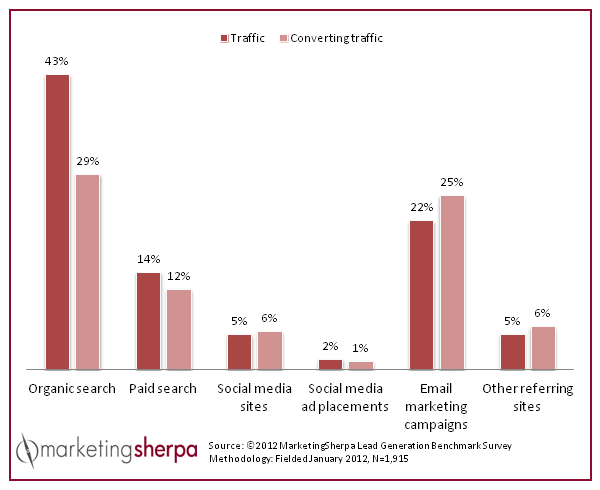
Mr. Magoo came to mind today as I was perusing a chart from those marketing information aggregators and analyzers at Market Sherpa.  The chart analyzed the best sources of website conversions.

Website conversions, as you may know, are when a visitor to your eCommerce website takes an action that transforms them from a visitor to prospect or customer.  The conversions we prefer are those where a customer either makes a purchase or submits their personal information which opens the door for further contact from our highly trained sales staffs.  Some automotive website vendors also include as conversions those visitors who click on the "Hours and Directions" link.  (To what degree this is a true "conversion" is the subject of many a lively discussion around the water coolers of the marketing universe.)

Here are the results Marketing Sherpa found when surveying to find the best sources for website conversion:
Source:  http://www.marketingsherpa.com/1news/chartofweek-10-30-12-lp.htm
To date I have tried to keep my articles fairly simple and basic for the digital marketing neophytes out there.  To that end, I am not interested in drilling deeply into the information contained in this study. (The Marketing Sherpa article itself does that far better than I would, anyway!)   I am going to share with you the observation that came to mind at first glance:  "Oh, Magoo, you've done it again!"  We are concentrating our efforts on those areas which provide the least return!

Most dealers know at this point that they have to do well in organic search.  This is most often tested by typing the dealership name into Google.  Unless you share a name with a larger urban behemoth somewhere else in the country, you usually show up quite well simply by default.  It is when we change the search term to a particular vehicle model that we sell combined with the name of our city or county that we become more concerned.  If you know what to look for, you see the organic search littered with third party vendors and paid search that might even feature competitors far away!

Too often this evokes a knee jerk reaction.  We have to show up on top!  The quickest route to get there?  Paid search, of course.  $800-$5000 per month later, we are on top of countless search term lists...but in the high rent district known as the "Sponsored Links".

Although it is falling out of vogue lately, many dealers ad Facebook ads, too.  It is, after all, recommended, right?  Using social media is all the rage in trade publications.  So we litter our social media pages with customer pictures, links to a particular inventory unit, or announcements that it is the end of the month and we are dealing!  Sometimes we subscribe to a content writing service that charges significantly for articles to blast on our Facebook and Twitter accounts.

Finally, we might opt for a greater spend with third party sites like Cars.com, AutoTrader, or Kelly Blue Book.  We will pay a little more for nifty banners and sparkly side ads in an effort to make sure we are all over the page when consumers are doing their search.

While none of these are bad ideas, if the research by Marketing Sherpa is accurate then we may be suffering from the same myopia as the loveable Mr. Magoo!  The chart shows that the actions we most frequently default to give us the least return!

According to our Sherpas, the most effective means to garner conversions are organic search and email campaigns.  It makes sense, too, when you think about it.  So why do we avoid these two highways to prosperity?  Because it is harder to understand how to do these well.  We are car people, and to do content or develop and test email marketing materials requires creative ad people.

Organic search after the great Google Penguin invasion has become more challenging.  To Google's credit, those websites wishing to gain organic prominence need to become living, vibrant sources of relevant information.  This challenges the dealer to move from websites that resemble a digital version of the traditional Sunday newspaper full page ad to websites that engage, inform, and most importantly spur consumers to choose us as their dealership of choice when they purchase!

Email campaigns can be a challenge, too.  There are no shortage of vendors with many and varied email marketing products out there.  Even if you use a vendor, though, it still takes time to determine to whom in your database you intend to send email solicitations and what you want those solicitations to contain.  Add the specter of Spam filters and email campaigns can become the most intimidating media for the dealer to use.

The path of least resistance and greatest expense leads to third party vendors who will handle the tasks of search optimization and targeting email marketing.  But why not do it in house?  Besides having more creative control and people working on your material who understand your dealership more intimately because they are a part of it, too, in house marketing allows you to test, retest, and then run with what truly works best for your individual operation!

Google Analytics allows you to publish two different sites and measure the results.  A good CRM tool combined with a staff that understands how to use it and read its reports allows you to test market your marketing materials.  Which email works better?  Which web page design attracts more click-thrus?  While you and your entire dealership family may love your site or the clever email you are sending out, if it does not resonate with your target consumers and result in visits to the dealership it is a waste of time.

Many of us believe America is about hard work, self-reliance-- why we are a nation of rugged industrialists like John D. Rockefeller!  A quick glance at the expanding welfare rolls, though, and we discover that we are increasingly a nation of Honey Boo-Boos!  Perceptions are nice, but a good marketer needs to understand the reality of their target market.


May I make a bold suggestion?  Let's have a paradigm shift in our dealerships.  Among our ranks of "car guys" why don't we add one or two creative content generators?  That's right, add to the payroll someone whose job it is to write compelling ad copy for both our websites and our email campaigns.  Let's find someone who can handle the mechanics of HTML code, SEO content generation, and graphic arts.  Replace our fascination with the relic who has been in the business for twenty years and therefore knows "the car business" with a curiosity for the person who can deftly and accurately aggregate the labyrinth of Google Analytics data into an easily understood assessment of our situation.

In short, let's relax our obsession with drawing a direct line between each sale and the person(s) on the staff who caused it to happen.  Make room at the table for one or two non traditional dealership employees whose jobs are to make our Internet presence engaging, evolving, and most importantly -- effective.

You will not have to forgo accountability.  Accountability will just take on new forms.  Instead of just measuring closing ratios or sold units we will begin  measuring trends.  Did our exposure online increase over last month?  Are visitors to the website visiting more pages or spending more time on our site?  Did more visitors send in emails?  Have phone calls increased?  If the answer to any of these questions is "No", then you need to look deeper into the data to answer "why".

A good content team should result in an increase in the number of people visiting our sites, the length of time spent on the site, and most importantly an increase in the number of phone, email, and walk-in leads. The degree of data you can cull from a well executed Internet marketing plan is staggering.  In fact, you have a far greater risk of "analysis paralysis" than you do of lacking tracking data.

It should not take long until you are fully in charge of the two aspects of marking that will give you the most conversions:  relevant content that fuels organic search and targeted email campaigns.

So let's look beyond our immediate comfort zone.  Let's look into building in house what works best for filling up our appointment calendars and sold logs.  If nothing else, at least you can change the discussion in the huddle from how hopeless conditions at the dealership are to why in the hell the company would have hired a couple of odd looking geeks!

---------------------------

Thank you for reading my article.  For nostalgia sake, and as a treat for having endured my ramblings, shall we enjoy some Mr. Magoo?