Monday, November 25, 2013

Marvin - Brilliant, underappreciated, nonetheless devoted.

Who the hell is Marvin?

This blog spawned from the wave of disappointment, betrayal, abandonment and despair brought about by my dismissal from the Great Lakes Auto Network.  I won't rehash the details but suffice to say I knew digital marketing best practices and yet was taken out by old school car guys who think that digital watches are cutting edge.  As an ardent fan of Douglas Adams' Hitchhiker's Guide to the Galaxy trilogy, how could I not identify with Marvin the Robot?

To me, the title was a clever allegory, but today I realized that for all my marketing savvy, I failed to consider whether my audience would know who Marvin was.  Few things are as humbling as yelling about the emperor having no clothes whilst yourself being completely naked.  Sure, I knew Marvin, but would anyone else get the metaphor?

Well, my cherished reader, today I seek to remedy this narcissistic oversight with the following little essay:

"Why I Feel Like the Marvin the Depressed Robot of the Digital Marketing World"
by Jeff Novak
     Really Smart Depressed Human Marketing Enthusiast

If you have not read Douglas Adams' The Hitchhiker's Guide to the Galaxy then you should.  In fact, now is a good time.  Do your inner misanthropic cynic a favor and give him/her an endless river of therapeutic laughter.

One of my favorite characters in this five book trilogy was Marvin the Robot, aka Marvin the Paranoid Android (despite his complete lack of paranoia).  Marvin was a rejected prototype of the Sirius Cybernetics Corporation.  Marvin had a brain the size of a planet and could do incalculable (except to him) computations in an instant.  As a service robot, however, he was pressed into service to do simple tasks at the whim of whoever was in possession of him at any given moment.  As a prototype of SCC's Genuine People Personalities (GPP) Marvin possessed intelligence and emotion.  You can imagine, then, the depression that would result from so great a mind as his being enjoined to perform the most banal tasks imaginable by beings whose intelligence is, by comparison, insignificant.

Let me share some quotes used by Douglas Adams to endear his readers to this very popular character:

“Funny,” he [Marvin] intoned funereally, “how just when you think life can’t possibly get any worse it suddenly does.”


On being left through a quirk in infinite improbability and time travel for fifty million years on a planet by the protagonists: “The first ten million years were the worst," said Marvin, "and the second ten million years, they were the worst too. The third ten million years I didn't enjoy at all. After that I went into a bit of a decline.” 

“Pardon me for breathing, which I never do any way so I don’t know why I bother to say it, oh God, I’m so depressed.” 

 So is it unbridled hubris which leads me to associate myself with Marvin?  Yes and no.

I am not the first to notice that the corporate world so often makes so little sense.  Its folly has long been lampooned by those far more talented than me.  The Office, Dilbert, Office Space et al.   How does a company continue to make money when propelled by seemingly endless and illogical decisions?  Doesn't a company have to do all those things they teach in those ivy league schools to succeed?


The answer, at least based on my experience, is "nope."

 In my first entry I likened myself to Camus' Sisyphus, diligently pushing forward with new ideas and best practices only to reach the top and have management knock the rock back down the hill.  Perhaps I am a zealot, or perhaps more accurately a masochist, but I have the insufferable optimism to keep encouraging my employers to let me move forward with new ideas.  Why can't I accept mediocre results.  Why can I not stand like the others and compliment the emperor on his fine flesh tone robes?  Why can I not look at that damned rock at the bottom of the hill and vow to just look like I'm pushing?  My late father won't let me.

My father drilled into my head as all good fathers do that I should work hard -- harder than everyone else.  While in his machine shop your hard work was reflected in the widgets you had produced, or on a job site the sweat pouring from your brow, people cannot appreciate hard work or talent that goes on in one's head.

In 1913 psychologist John B. Watson administered a lecture at Columbia University entitled "Psychology as the Behaviorist Views It" (Psychology fans will find it here) in which he brings to the world of psychology the idea of studying the psychology of behavior.  His most famous experiment involved scaring the hell out of a little kid named Albert with rats. ("Making Sense of Autism..."James Copeland MD)
After discovering that the academic world frowns on professors who study the effects of professorial mojo on their research assistants, John Brodus Watson took his research and his skills to the field of advertising where, according to Mad Men, indiscreet liaisons are what one does during lunch with the secretary pool.

In the time since Watson, behavior science has taught us much.  Advertisers began to use this science to affect greater response from their advertising targets.  (They also benefited from the influx of horny professors that could give them tips on how to use science to get the most out of the aforementioned secretarial pools.) 
I wonder what it was like for marketers at the time to see the arrival of science to their trade.  Who was this Watson guy?  What of behavioral study?  What does that have to do with painting really pretty shingles to hang over the door of our client?

In the past one would measure advertising success with quarterly sales reports.  "Gut" would often determine if a campaign worked or not.  The addition of science would bring about focus group testing, product trials, polls.  The better advertising could quantify its results, the more effective it would become.

Now comes the digital age.

The Internet has flourished with dizzying speed, and it's evolution takes days, sometimes hours.  In the midst of it rose Google, a company initially concerned with producing relevant search results for their users that became an information and analytical juggernaut.  Gone are the days of spending on billboards, magazine ads, radio spots and the wait for periodic sales reports.  Digital analytics lets you see how your ads are performing.  Heat maps and A/B testing platforms let you test your web design in real time using the site visit data of the actual users you are targeting.  Can you imagine what Don Draper could have done with accurate and quick data like this?


It does not stop there, however.  The digital advertiser has at his disposal tools that reveals where your target market is looking online.  Complex algorithms have been developed to try to pinpoint how close your prospect is to making a purchase.  eCommerce giants like Amazon can predict which additional items you are most likely to include in your current purchase.  Look up something in search and everything else you do is plastered full of ads relevant to what your search patterns.  Imagine the Reader's Digest in the doctor's office knowing you were just reading about how to refinish antique furniture, slowed down for a sign at a used furniture store, and were looking at wood finishing supplies at Home Depot.  It then suddenly switches the article on the cover from "How I Narrowly Escaped Being Targeted by a Nigerian Prince with an Escrow Problem" to "I Restored Grandma's Chifferobe".  This can happen online - a marketer's wildest fantasy can be the Internet's reality.


It doesn't end there.  In fact, it doesn't end.  Digital marketers are moving on to concepts like geo-fencing.  Soon your Firestone tire store can make an ad pop up on your customer's smart phone as they pull into a Goodyear store.  The explosion in smart phones and tablets opens the door for marketers to literally travel with you, offering advice and counsel at every turn.

So what does all of this have to do with me?  Like Marvin knows about infinite improbability hyperspace drives, I know something about this stuff.  I know the marketing tools that are out there and have even had success applying them.  I can look at an automobile dealership's operation, analyze their message (in those rare cases where such a consistent message exists), and find ways to expand their reach.  The good Lord gave me a talent for language and a creative mind.  I can do digital advertising -- But like Marvin I am surrounded by those who don't understand.  What's worse, this is how I make my living, and in the end dealerships always seem to eschew what is new and strange so as to default back to their comfort zone.  They do this even when it makes no logical sense.

Only six percent of dealership marketing decisions are based on actual data.  In fact, data is typically anathema to the automotive dealership.  They count the number of "X's" on the sold board, they calculate the amount of profit, and they see if they sold more than last year.  The concept of measuring the site metrics of their website, the trending of viewers looking at their inventory, the breadth of data they can find with their Customer Relation Management software to find strengths and weaknesses -- all receives scant attention.  And woe to him that brings it up!

One of my favorite passages in The Hitchhiker's Guide lampoons this very concept.  It involves infinite improbability fields but it makes the point:

The principle of generating small amounts of finite improbability by simply hooking the logic circuits of a Bambleweeny 57 Sub- Meson Brain to an atomic vector plotter suspended in a strong Brownian Motion producer (say a nice hot cup of tea) were of course well understood - and such generators were often used to break the ice at parties by making all the molecules in the hostess's undergarments leap simultaneously one foot to the left, in accordance with the Theory of Indeterminacy. 

Many respectable physicists said that they weren't going to stand for this - partly because it was a debasement of science, but mostly because they didn't get invited to those sort of parties.
Another thing they couldn't stand was the perpetual failure they encountered in trying to construct a machine which could generate the infinite improbability field needed to flip a spaceship across the mind-paralysing distances between the furthest stars, and in the end they grumpily announced that such a machine was virtually impossible. 

Then, one day, a student who had been left to sweep up the lab after a particularly unsuccessful party found himself reasoning this way: 

If, he thought to himself, such a machine is a virtual impossibility, then it must logically be a finite improbability. So all I have to do in order to make one is to work out exactly how improbable it is, feed that figure into the finite improbability generator, give it a fresh cup of really hot tea ... and turn it on! 

He did this, and was rather startled to discover that he had managed to create the long sought after golden Infinite Improbability generator out of thin air. 

It startled him even more when just after he was awarded the Galactic Institute's Prize for Extreme Cleverness he got lynched by a rampaging mob of respectable physicists who had finally realized that the one thing they really couldn't stand was a smartass.
[http://www.ebooktrove.com/top_ten/DouglasAdams_TheHitchhikerTrilogy_5Books1ShortStory.pdf]


Now that I have pointed out what is wrong with the rest of the world, let me share with you what is wrong with me.  I love marketing.  I love creating a message that moves people to act.  I love measuring my message, analyzing it as critically as possible.  I love unique messaging.  I love thinking outside the box -- often  way outside.  Marketing and sales process is for me a passion that borders on obsession.

My recent stint with Community Chevrolet demonstrated that I am good at it, too.  They did not know what they needed to do so I was given license to do almost whatever I wanted.  (Whatever I wanted, by the way, never translates into throwing huge sums at vendors and the latest gimmick.  I am far too fond of controlling my message for that!)  In the end their used car sales soared 91% and their new 27%.  It was for me an affirmation that all those stats and best practices I had studied were actually relevant to this business.  I have finally pushed the rock up the hill - to its peak, no less!


Then the damned thing rolled right over me.


During a market slump the salesmen corner the owner to assert that the BDC call agent was inexperienced and that is why sales are down.  The owner fired the BDC agent (who happened to be my son).  My son gets picked up immediately by a competitor and I am fired in a fit of pique because I did not forbid him to take the other job.

In case you're wondering -- no -- not one piece of empirical data was used in any of these decisions.

So call it hubris, cynicism, or a completely delusional self image I can relate to Marvin.  I don't share his near infinite knowledge, but I share his hamartia, or fatal flaw as it were.  Marvin cannot help but compute complex problems.  His mind won't allow him to settle for the banal.  He thinks because he is, and who he is compels him to think, to calculate -- and to feel.  In addition to being infused with voluminous data, he is also programmed to feel, and he feels like no one can relate well to him.

People can see sweat. People can count the widgets you have produced. But people cannot always see that what you are saying is right, that you know what you are doing, and that you can translate theory into success. 

I have a passion for what I do.  I know that it works -- and I have a work ethic that propels me to do the very best, well in excess of expectations.

Now if only I could accept that for many, the status quo is their comfort zone, an just play the game?  No way.


Works cited:
http://www.psychologytoday.com/blog/making-sense-autistic-spectrum-disorders/201008/020-thorndike-watson-founding-fathers-behaviori

http://pages.pomona.edu/~rt004747/lgcs11read/Watson13.pdf

http://www.muskingum.edu/~psych/psycweb/history/watson.htm

Friday, November 9, 2012

Oh, MaGoo, you've done it again!

Oh Magoo, you've done it again!

Who can ever forget the lovable Mr. Quincy Magoo.   One of the first successful human cartoon characters, this Oscar winning Rutgers alumnus would venture out with his severe myopia and hijinks would ensue.   

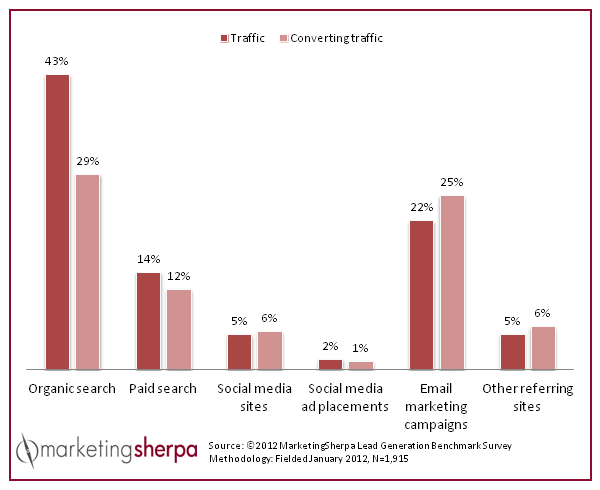
Mr. Magoo came to mind today as I was perusing a chart from those marketing information aggregators and analyzers at Market Sherpa.  The chart analyzed the best sources of website conversions.

Website conversions, as you may know, are when a visitor to your eCommerce website takes an action that transforms them from a visitor to prospect or customer.  The conversions we prefer are those where a customer either makes a purchase or submits their personal information which opens the door for further contact from our highly trained sales staffs.  Some automotive website vendors also include as conversions those visitors who click on the "Hours and Directions" link.  (To what degree this is a true "conversion" is the subject of many a lively discussion around the water coolers of the marketing universe.)

Here are the results Marketing Sherpa found when surveying to find the best sources for website conversion:
Source:  http://www.marketingsherpa.com/1news/chartofweek-10-30-12-lp.htm
To date I have tried to keep my articles fairly simple and basic for the digital marketing neophytes out there.  To that end, I am not interested in drilling deeply into the information contained in this study. (The Marketing Sherpa article itself does that far better than I would, anyway!)   I am going to share with you the observation that came to mind at first glance:  "Oh, Magoo, you've done it again!"  We are concentrating our efforts on those areas which provide the least return!

Most dealers know at this point that they have to do well in organic search.  This is most often tested by typing the dealership name into Google.  Unless you share a name with a larger urban behemoth somewhere else in the country, you usually show up quite well simply by default.  It is when we change the search term to a particular vehicle model that we sell combined with the name of our city or county that we become more concerned.  If you know what to look for, you see the organic search littered with third party vendors and paid search that might even feature competitors far away!

Too often this evokes a knee jerk reaction.  We have to show up on top!  The quickest route to get there?  Paid search, of course.  $800-$5000 per month later, we are on top of countless search term lists...but in the high rent district known as the "Sponsored Links".

Although it is falling out of vogue lately, many dealers ad Facebook ads, too.  It is, after all, recommended, right?  Using social media is all the rage in trade publications.  So we litter our social media pages with customer pictures, links to a particular inventory unit, or announcements that it is the end of the month and we are dealing!  Sometimes we subscribe to a content writing service that charges significantly for articles to blast on our Facebook and Twitter accounts.

Finally, we might opt for a greater spend with third party sites like Cars.com, AutoTrader, or Kelly Blue Book.  We will pay a little more for nifty banners and sparkly side ads in an effort to make sure we are all over the page when consumers are doing their search.

While none of these are bad ideas, if the research by Marketing Sherpa is accurate then we may be suffering from the same myopia as the loveable Mr. Magoo!  The chart shows that the actions we most frequently default to give us the least return!

According to our Sherpas, the most effective means to garner conversions are organic search and email campaigns.  It makes sense, too, when you think about it.  So why do we avoid these two highways to prosperity?  Because it is harder to understand how to do these well.  We are car people, and to do content or develop and test email marketing materials requires creative ad people.

Organic search after the great Google Penguin invasion has become more challenging.  To Google's credit, those websites wishing to gain organic prominence need to become living, vibrant sources of relevant information.  This challenges the dealer to move from websites that resemble a digital version of the traditional Sunday newspaper full page ad to websites that engage, inform, and most importantly spur consumers to choose us as their dealership of choice when they purchase!

Email campaigns can be a challenge, too.  There are no shortage of vendors with many and varied email marketing products out there.  Even if you use a vendor, though, it still takes time to determine to whom in your database you intend to send email solicitations and what you want those solicitations to contain.  Add the specter of Spam filters and email campaigns can become the most intimidating media for the dealer to use.

The path of least resistance and greatest expense leads to third party vendors who will handle the tasks of search optimization and targeting email marketing.  But why not do it in house?  Besides having more creative control and people working on your material who understand your dealership more intimately because they are a part of it, too, in house marketing allows you to test, retest, and then run with what truly works best for your individual operation!

Google Analytics allows you to publish two different sites and measure the results.  A good CRM tool combined with a staff that understands how to use it and read its reports allows you to test market your marketing materials.  Which email works better?  Which web page design attracts more click-thrus?  While you and your entire dealership family may love your site or the clever email you are sending out, if it does not resonate with your target consumers and result in visits to the dealership it is a waste of time.

Many of us believe America is about hard work, self-reliance-- why we are a nation of rugged industrialists like John D. Rockefeller!  A quick glance at the expanding welfare rolls, though, and we discover that we are increasingly a nation of Honey Boo-Boos!  Perceptions are nice, but a good marketer needs to understand the reality of their target market.


May I make a bold suggestion?  Let's have a paradigm shift in our dealerships.  Among our ranks of "car guys" why don't we add one or two creative content generators?  That's right, add to the payroll someone whose job it is to write compelling ad copy for both our websites and our email campaigns.  Let's find someone who can handle the mechanics of HTML code, SEO content generation, and graphic arts.  Replace our fascination with the relic who has been in the business for twenty years and therefore knows "the car business" with a curiosity for the person who can deftly and accurately aggregate the labyrinth of Google Analytics data into an easily understood assessment of our situation.

In short, let's relax our obsession with drawing a direct line between each sale and the person(s) on the staff who caused it to happen.  Make room at the table for one or two non traditional dealership employees whose jobs are to make our Internet presence engaging, evolving, and most importantly -- effective.

You will not have to forgo accountability.  Accountability will just take on new forms.  Instead of just measuring closing ratios or sold units we will begin  measuring trends.  Did our exposure online increase over last month?  Are visitors to the website visiting more pages or spending more time on our site?  Did more visitors send in emails?  Have phone calls increased?  If the answer to any of these questions is "No", then you need to look deeper into the data to answer "why".

A good content team should result in an increase in the number of people visiting our sites, the length of time spent on the site, and most importantly an increase in the number of phone, email, and walk-in leads. The degree of data you can cull from a well executed Internet marketing plan is staggering.  In fact, you have a far greater risk of "analysis paralysis" than you do of lacking tracking data.

It should not take long until you are fully in charge of the two aspects of marking that will give you the most conversions:  relevant content that fuels organic search and targeted email campaigns.

So let's look beyond our immediate comfort zone.  Let's look into building in house what works best for filling up our appointment calendars and sold logs.  If nothing else, at least you can change the discussion in the huddle from how hopeless conditions at the dealership are to why in the hell the company would have hired a couple of odd looking geeks!

---------------------------

Thank you for reading my article.  For nostalgia sake, and as a treat for having endured my ramblings, shall we enjoy some Mr. Magoo?

Wednesday, October 31, 2012

I'm in my own little world, but it's ok, they know me here!

My eldest son showed up with a tee shirt to this effect one day:
 I loved the utter simplicity of the message complete with that ironic twist that every little saying will need one day if it aspires to tee shirt prominence.  It came to mind again today when I was pondering car sales.  What is typically the least cultivated source for high gross deals?  Repeat and referral business.  They are in our little world.  They know us.  By and large, we close our eyes, click our heels, and hope that they feel that there is no place like our dealership, there is no place like our dealership...

We know this not to be the case, though.  Three to five years is a long time.  Our society has shifted from traditional brand loyalty to one that espouses a narcissistic instant gratification.  The more we stay in the forefront of our sold customers' minds, the better our odds of turning them into loyal, repeat buyers.

To this end often dealers use various third party vendor tools, many of them largely service related.  This is good in that not only does it keep your name before their eyes, but also because it fosters a relationship and, best of all, increases the lifetime value of our relationship with them.

Our very best career salespeople know the importance of repeat and referral business and typically have some sort of method in place to reach out to their sold customers on a regular basis.  Surprisingly not all veteran salespersons do this, leaving far too many that just rely on attracting a handful of loyal customers every year to their roster over the course of ten or fifteen years. 

The all too frequent staff turnover in our industry leaves a good number of our customers orphaned.  Sure, they are called every time a new green pea hits the floor and is handed by the busy manager that tattered list of old customers to call, but relationships are rarely fostered with these random, unplanned and largely unscripted calls.

Manufacturers looking to boost their JD Powers customer satisfaction percentages typically require their franchise dealers to send out an obligatory post sale "thank you" letter.  I knew an owner who used to also send out an awkwardly worded thank you of his own, too.  We all have some "thing" we do for sold customers, but do we have a well drafted and equally well executed "process"?

It doesn't take long to draft such a workable "process".  Choose your time table, select your media (letter, email, coupons/offers), assign responsibility.  What bedevils most dealers is getting the process to be followed consistently.  Like so many great ideas we have, post sale follow up works so well we stop doing it.

This is where automation becomes so valuable.  If we take the time to set up our process, whatever it is, into a software program whose automation helps to overcome the omission caused by our human frailty, we stand a better chance at being consistent!  So where in your dealership do you find those best equipped to set up and monitor a working repeat/referral business plan?  Your Internet Department, of course!

Most CRM tools are able to trigger tasks that include sending letters or emails on specific anniversary dates, putting phone call reminders in the salespersons' "To Do" lists, and generating lists for targeted  marketing campaigns.  In small dealerships, it is the Internet Department that is typically most adept at using the CRM tool.  (Far too often they are the only ones who use the CRM software tool.)  It therefore only makes sense to empower them to program the CRM tool to include a repeat/referral process.

Not only does this serve to tear down the outmoded concept of the Internet Department as "those salespeople that take care of Internet leads", it begins to develop your Internet staff into a more expansive digital marketing asset for your dealership. 

Because there are still a good number of salespeople who are intimidated by or lack the skills to utilize your CRM tool well, your Internet team can begin to serve as peer coaches. Their skill and enthusiasm will help make the use of your CRM tool for things beyond just inputting new customers less intimidating.


Adding a repeat/referral business process to an already well executed Internet lead process cannot help but increase sales.  You will begin to have a more well rounded team and a more sustainable business model, too.  The automation will serve to allay our natural tendency to drift away from our best practices.  The task reminders will help those salespersons watching for fresh ups to not forget the equally important and more profitable opportunities found among their sold customers.  With your veteran staff filling their calendars with the better grossing repeat/referral prospects, you will soon be recruiting new salespeople to handle the drive in traffic!

Everybody wins.


Elements of a basic Repeat/Referral Process: 
  • Auto generated follow up letter from the salesperson.
  • Next day follow up phone call
  • Thirty, sixty, ninety day follow up phone calls (use a good referral script).
  • Newsletter email blasts every 45 days.
  • Birthday/sale anniversary phone call tasks.
Taking it to the next level:
  • Service coupons/email offers
  • Model specific email campaigns deeper into their ownership cycle
  • End of lease calls/offers. 
 

Thursday, October 25, 2012

"Just looking" - Reflex reactions aren't limited to customers.

Any good salesperson knows that the last way you want to greet a customer is with the words,

"Can I help you?"  

Sales 101 teaches that you will guarantee yourself that famous reflex reaction that stymies your sales efforts:

"Just looking!"

This most basic of all reflex reactions thrusts the novice (or lazy/skill deprived) salesperson into sales purgatory.  If your sales manager is not watching, you will make sure you give them your name and let them know exactly where in relation to the coffee machine you will be standing explaining to your coworkers why these people are probably not buyers -- so they can find you when they have found what they are looking for.  (This also happens to be the salesperson version of dogs peeing on a bush to mark their territory.  These customers are now "upped", meaning that this salesperson has exclusive rights to any purchases these people make by virtue of the fact that he/she first said words to these people.)

I professionally "upped" them so if they buy within the next three years they are my customer!
If your sales manager is watching, you are condemned to perform the "stalker walk", following them from item to item until they either flee on the wings of some lame excuse to free themselves from this awkward situation or until they ask you a question, thus absolving you from your sin of ineffectiveness and letting you begin your version of the sales process.

For a couple of weeks now I have been attempting to find a new home for my marketing experience and talents.  It has been frustrating to say the least.  Upon reflection, however, I realized that I was approaching it in much the same way as a novice or lazy/unskilled salesperson.  I was walking in, asking for a dealer principle, handing him/her my resume and explaining, "I was wondering if we can talk about what I can offer your Internet marketing efforts!"

If you ask a dealer principle, general manager, sales manager, etc. to consider letting you help their digital marketing efforts they, too, have reflex responses.  Most fall into these three categories:

"We already have someone who does Internet for us."
"What we do now is working for us, we aren't looking to add anything right now."
"Yeah, we know we need to do something about it.  We just aren't sure what yet."
We have someone.
Having grown up in Geneva I remember my father walking home one day with his pink slip, a victim of the closing of the True Temper plant I am never in favor of replacing someone with whom you are satisfied simply because someone else has shown up with strong credentials, too.  At the same time, is one person sufficient for the digital marketing efforts of the modern automobile dealership?  What does your "Internet person" do?   Is he/she doing many things adequately or just a few things very well?  How heavily do you rely on more expensive third party vendor options?  Could a larger staff execute a more comprehensive plan and still be profitable for you?  If you have not asked these questions in the last ninety days, perhaps you should!

We are fine, thank you.
This has to be the most maddening reflex response of all.  This is the "just looking" of the managerial vernacular.  If it is just being said to avoid a discussion with a resume bearing unemployed Internet manager or third party vendor salesperson, etc. then it can be forgiven.  Aside from that, what manager ever believes that their plan and process is so beyond scrutiny that any review of it is pure folly and a waste of time?  Could you imagine the CEO of a major corporation addressing a meeting of the stockholders with a brief statement like this: "Thank you, ladies and gentlemen. Everything is great.  See you next year."?

You know we should look into this.
If you climb a mountain to its summit to find a robed and bearded guru from whom to solicit advice, he will no doubt begin by teaching you that the first step to any problem is to admit that there is a problem. There are so many facets to the modern automobile dealer franchise that excelling in every single one of them is nearly impossible.  When you remain open, however, to exploring how to improve when the opportunity presents itself you are inarguably more likely to find success in multiple areas than those for whom constructive scrutiny is just too vexing. 


So what do I do?
My primary recommendation is that you call me and offer me ungodly sums of money in exchange for maximizing your digital marketing efforts.
 

In the absence of that there are a some core elements upon which a good Internet marketing process should be builtHybrid roses offer a myriad of different colors and varieties for the flower gardens of the world, but they are usually all grafted to the hardy root system of a wild rosebush.  So, too, you should make sure your Internet strategy is grafted onto these trusted, basic tenets of automotive digital marketing:

Feature a good quality product.
Your primary objective is to sell cars, period.  Make certain that your inventory listings are designed to elicit a response from those who see themYou do not need an elegant studio in which to stage your cars (though it can help) but you should make sure that your pictures are clear, accurate, and informative.
  • Does your vehicle fill most of the frame of the pictureAre they well focused?  Is lighting or glare a significant hindrance?
  • Is your description correct?  Does it feature an accurate trim level and include the most important or unique options?  Did you update the mileage on demo units?
  • Do you have engaging ad copy in the description?  Is it relevant to the vehicle?  Does it answer the most basic questions about the vehicle. (You would be surprised, by the way, on how much more people rely on the pictures than the descriptions for feature/trim information.) Do you point out significant damage or defects in your pictures or descriptions?  (It's not as though a customer is not going to notice when they arrive.)
You wouldn't buy clothes that were all crumpled up on the floor of a fancy clothier, would you?  Your inventory feed is your prospect's first exposure to your primary product.  Make your first impression a good (and accurate) one!  

Find your story and tell it well.
Believe it or not: not every dealer is the #1 biggest volume primary source of the most amazing ever expanding all encompassing inventory at the lowest below invoice pricing in the tri-state area that specializes in giving you an amazing difference that results in the greatest customer satisfaction of anyone anywhere who also happens to give you more for your trade than anyone else ever will because they sell more cars than all other local dealers combined!


All dealers have those facets of the automotive sales business in which they absolutely excel.  Discern your greatest strengths and use good ad copy and images to portray it simply and succinctly on your company website.  Present your story, not just a template of what automobile dealer sites are supposed to say.  People tune out a preponderance of cliches.  Make your site reflect who you are and in what you excel. A high end luxury dealer's site should not look and read like a modest, low end economy dealer's site -- and vice versa!

We caught one! Now what?
All of the above becomes an exercise in futility in the absence of a good Internet lead process.  If you put ten salespersons or marketing professionals in a room, you will get eleven opinions on what the lead process should look like.  On one point they should all agree:  your process should never be etched in stone.  As market trends ebb and flow so, too, should your response tactics constantly be edited, tested, and tweaked.  Here are some points to consider:
  • If you use an auto-responder, it should contain simple calls to action.  Remember, too, that brevity is the soul of wit!  Avoid sending a Charles Dickens manuscript as your auto-responder.
  • Answer quickly.  Forget the OEM clock, you should be answering leads quickly because it makes good business sense.  I've never heard anyone say, "strike after the iron cools off". 
  • Answer the question!  If your prospect has questions, answer them.  Don't try to sell the car via email or phone.  Your goal at this point is to sell the appointment.  Ideally you seek that balance between giving enough information to build trust and rapport and yet letting reasons remain to justify the prospect's need to come in to see you. You will never build rapport by ignoring the prospect's questions, though.
  • Calls to action: use them!  Every email correspondence should invite the prospect to proceed to the next logical step in the sales process.  
  • Build rapport and make every attempt to connect with your prospect.
The length and/or intensity of your follow up process or its contents all should be regularly discerned by the individual dealership.  If you have a high volume of leads, try two competing process models for a quarter and measure your results.  The point is that a good Internet strategy should include scrutiny, an openness to new trends/ideas, and an attention to the resulting data.

That's so crazy it just might work!
Finally, make sure you have a good Internet Marketing Manager at the helm.  Many opinions exist on what makes a good Internet manager.  I would propose, however, that whoever you choose and whatever his/her duties a good Internet professional should have difficulty sitting still.  The jetsam and flotsam churning about on the Web affects and influences our culture to a greater degree at every passing moment.  Good Internet marketing watches those trends, tries new approaches, and tests ideas carefully to determine what is most effective -- even if those results conflict with his/her personal biases.

Closing a deal hasn't really changed.  Automobile purchases are still largely based on emotional impulses.  What increasingly differs are the ways that we are attracting prospects to our sales staff and closers.  Internet trends are fluid and so, too, should be our Internet marketing.  A good Internet Marketing Manager realizes this and, while staying true to the fundamentals, is always looking to adapt the strategy and the message so as to stay relevant and effective.